
Exact commercial knowledge, the moment the agent needs it. 100% accurate prices. 100% accurate product facts. Deterministic, not probabilistic.

The System Prompt Catastrophe.
A selling agent has to know the customer’s business exactly: every product, every price, every exception, every objection and its answer, every competitor and how to position against it. Put all of that in the standing prompt of a real-time speech model and the prompt grows, attention thins, and the agent starts getting facts wrong at the moment they matter most. Nearly every AI-agent company is living in this catastrophe: prompts that look polished in a demo and break in a real conversation with a real consumer.
Separate behavior from knowledge.
CIS separates how the agent sells from what it knows. A compact behavioral prompt governs the selling. When the agent needs a fact, it calls one of four knowledge tools — product information, pricing, objection guidance, competitor intelligence — and CIS returns a small, structured, speech-ready playbook by deterministic exact lookup, addressed by customer, agent, document type, and category. There is no vector search and no second model in the serving path: the lookup is a database read, and the same request returns the same answer every time. Each document carries a speech-ready summary the agent can say and authoritative values that bind to machine variables, so the agent never calculates a price or reconstructs a transaction from memory.
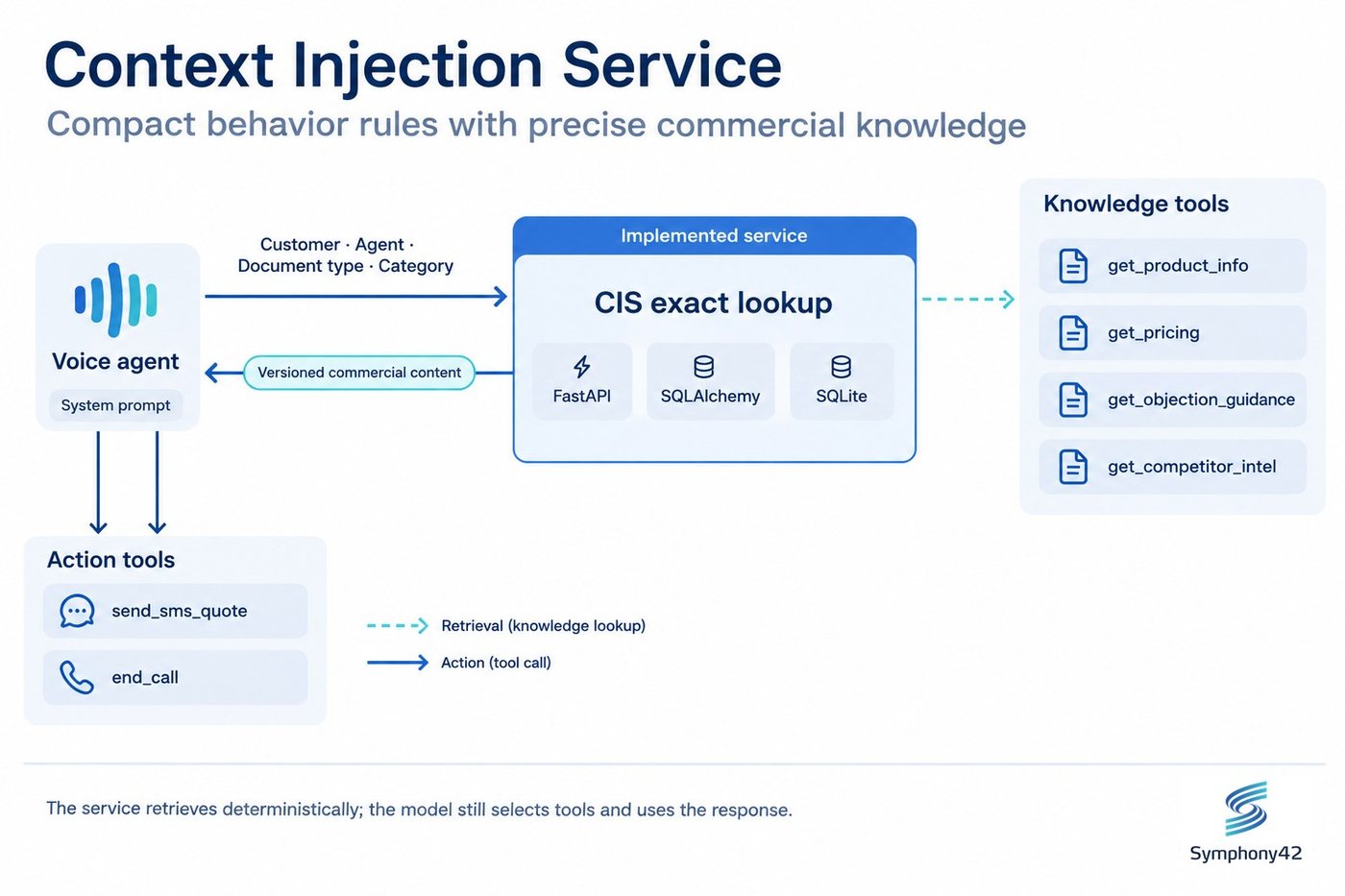
Example
A consumer asks what the plan costs for a family of four. The agent calls the pricing tool; CIS returns the customer’s current pricing document; the agent explains from the speech-ready summary while the authoritative price binds to the quote it will confirm. The consumer says a competitor is cheaper; the competitor-intelligence tool returns the approved positioning. The agent stays fluent, the facts stay exact, and the customer’s knowledge can be updated without touching the agent’s behavior.
Why it matters commercially
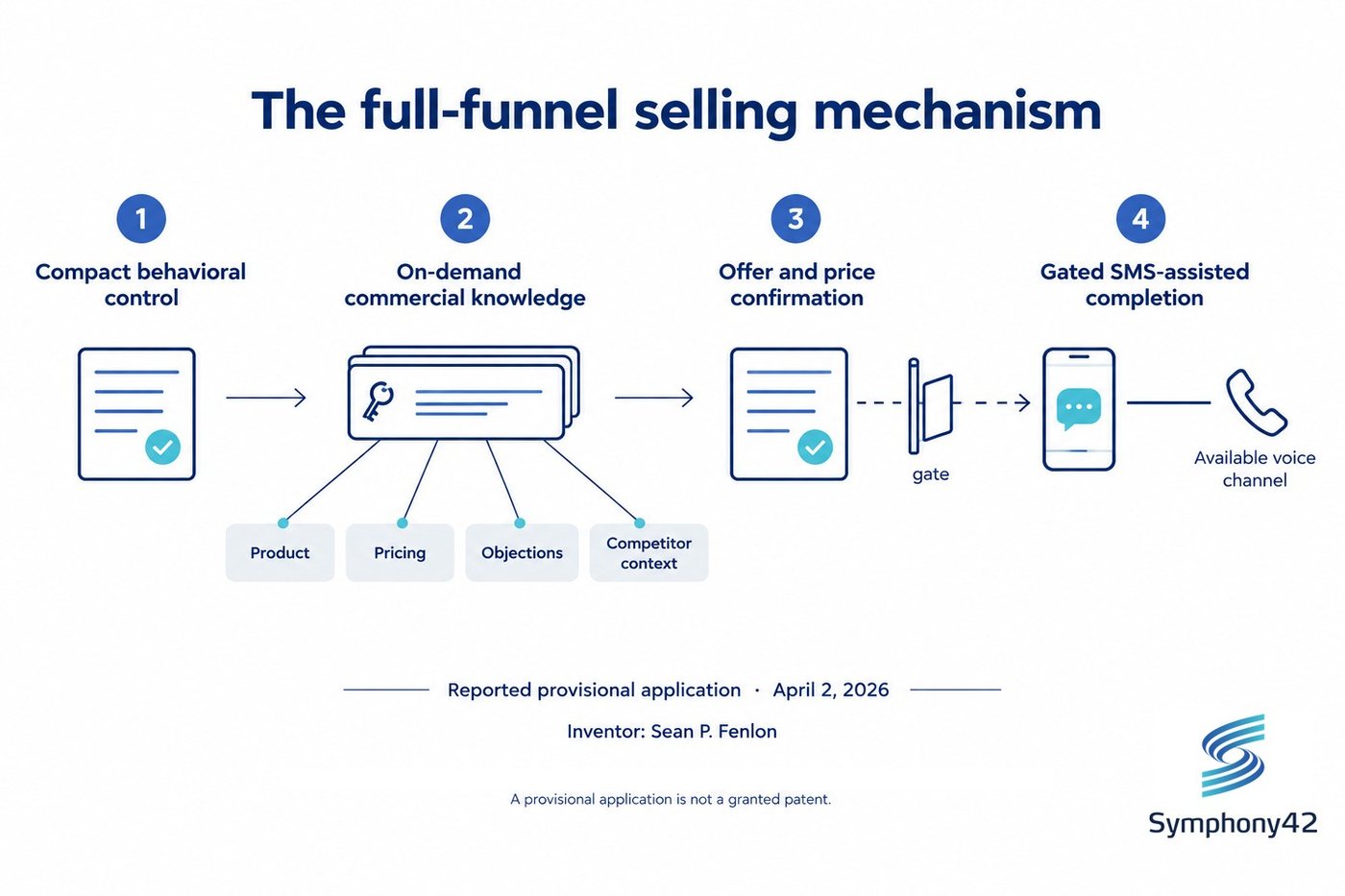
A customer with dozens of plans, exceptions, and price points can be sold by an agent whose standing instructions fit in a model’s attention. The knowledge lives beside the agent, maintained separately, versioned, fingerprinted, and updated transactionally, with a record of which edition served each call. It is the bridge from a real-time conversation to an exact transaction — the step that lets an AI agent own the bottom of the funnel instead of handing it to a human closer.
Status and intellectual property
CIS is live on the production call path with more than 140 knowledge documents serving Symphony42 agents today. The deterministic context-injection architecture is the core technical contribution of Symphony42’s U.S. provisional patent application “System for Enabling AI Voice Agents to Conduct Full-Funnel Sales Conversations,” filed April 2, 2026 (patent pending; not yet examined or granted).
Further reading
- Symphony42 — NEW INVENTION: Full Stack Customer Acquisition + MORE PROOF (April 2, 2026)
- How to Make Money with AI – Part 3: Prompt Engineering (July 4, 2025)