
By Sean Fenlon
Obligatory self-serving Symphony42 clickbait promo header here:
OMG!!! This New AI Startup Whispers Sweet Nothings to Your Wallet…
Symphony42.com New Website and Live Demos
Just one click will Make You Question Reality!!! :-O
WATCH and/or LISTEN to this article here:
https://www.youtube.com/watch?v=eByDvTnabGI
I. INTRODUCTION: The New Frontier of USA Innovation & Economic Growth
Today is Independence Day – the 4th of July (2024).
I am publishing this article today in honor of the United States of America – the greatest nation on Earth.
As we gather with our friends and family to celebrate the 248th anniversary of American independence, we find ourselves at the dawn of a new revolution. Exactly one year ago today, July 4, 2023, in “How to Make Money with AI – Part 1,” my LinkedIn article explored how AI represents the single greatest money-making technology breakthrough in human history:
[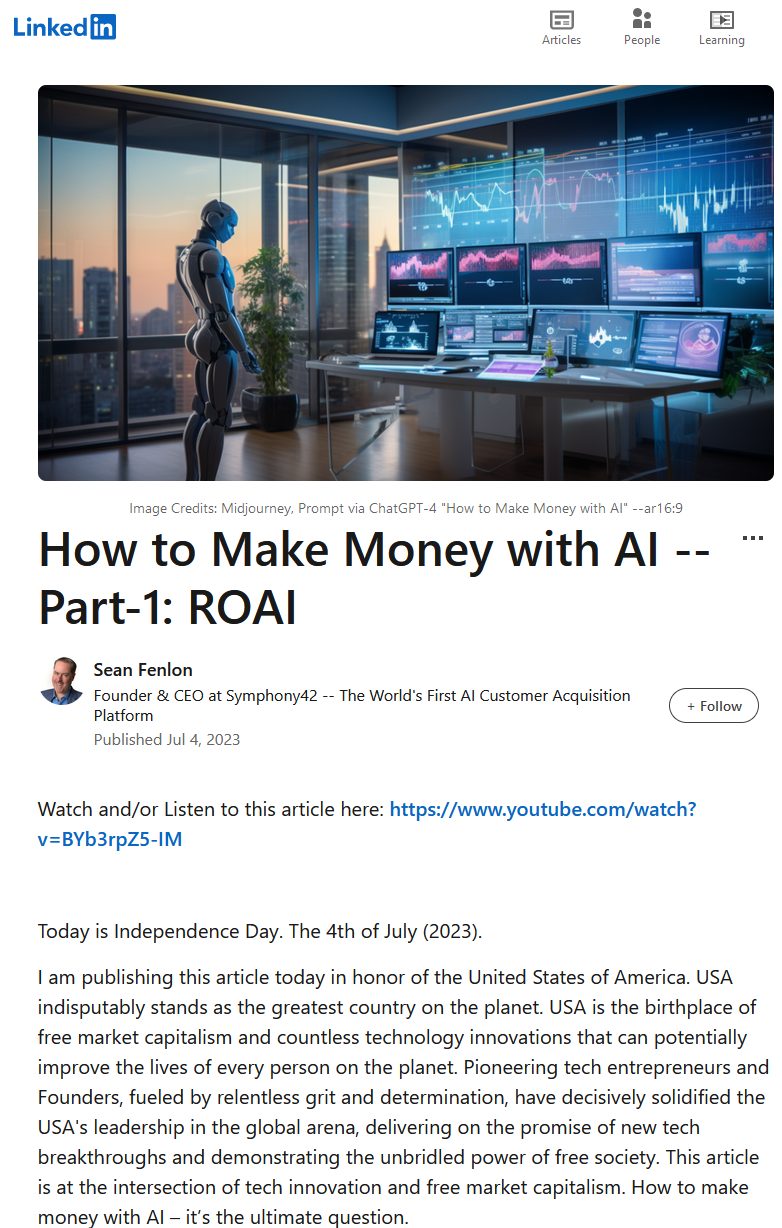
https://www.linkedin.com/pulse/how-make-money-ai-roai-sean-fenlon/](https://www.linkedin.com/pulse/how-make-money-ai-roai-sean-fenlon/)
Part 2 fortifies the claim and, today, we extend that vision to focus on AI Agents, the practical embodiment of AI’s transformative power.
The United States of America has always been a beacon of innovation and opportunity. Our unique blend of entrepreneurial spirit and free market capitalism has consistently placed us at the forefront of all technological revolutions. Now, as AI intersects with these quintessentially American dynamics, we stand on the brink of the most significant wealth-creation opportunity our world has ever seen.
AI has shattered all expectations in the mere 365 days since our last 4th of July reflection. The global AI market, valued at $86.9 Billion in 2022, is now projected to reach a staggering $407 Billion by 2027. This represents a compound annual growth rate (CAGR) of 37.3% – a pace that dwarfs even the rapid expansion of the Internet and mobile smartphones in their early days.
For perspective, it took the entire Internet economy until 2005 to surpass $100 billion in market size. AI is set to quadruple that benchmark in less than half the time :-O.
But market size alone doesn’t tell the whole story. AI is poised to inject between $2.6 and $4.4 Trillion (with a capital “T”) annually into the global economy. This translates to a projected 21% net increase in GDP by 2030. The impact on productivity is equally astounding, with AI expected to boost US productivity growth by more than 20X the impact the Internet had on total factor productivity growth in its early years.
In “How to Make Money with AI - Part 1,” Google’s meteoric rise and unprecedented success during the Internet revolution was used as a framework for success in the new era of AI. The article explored how Google leveraged the Internet’s potential for B2B2C customer acquisition to become one of the most valuable companies in the world. Today, in How to Make Money with AI Part 2, we take this concept further, diving deep into the world of AI Agents – the next evolution in AI’s money-making potential.
AI Agents, particularly Revenue-generating AI Agents, represent the practical application of AI’s mighty power. AI Agents are poised to revolutionize industries, create new business models, and drive unprecedented economic growth across the planet. Just as Google’s algorithms changed how businesses acquire customers, AI Agents are set to transform how companies interact with consumers, make decisions, and generate revenue.
It’s fitting to note that just as Part 1 of this (now a regular/annual) “How to Make Money with AI” series ended with a look at Symphony42, so too will Part 2. Symphony42’s innovative use of AI Agents in B2C Customer Acquisition serves as a real-world example of the principles we’ll explore in this article.
In the spirit of our Founding Fathers, who dared to envision a bold new nation built on the principles of liberty and opportunity, let us embrace this AI revolution. It’s a chance to reaffirm the USA’s dominant position as the global leader in innovation and economic prosperity.
As we unfurl our flags and light our fireworks today, let’s also ignite our entrepreneurial spirit. The next chapter of American economic greatness is ours to write, one AI Agent at a time :-)
II. THE EVOLUTION OF AI: From AI Tools to Autonomous AI Agents
Just as the Industrial Revolution transformed manual labor into mechanized production, and the Internet Revolution turned consumer data into the new oil, we now stand at the precipice of the AI Agent Revolution. This marks the evolution of AI from mere machine-learning tools to autonomous actors in the global economy.
Defining AI Agents: Capabilities and potential
AI Agents are the next leap forward in how to make money with AI – even bigger than the jump from landlines to smartphones. Where traditional AI systems are like computers/calculators – powerful but limited to specific tasks via step-by-step user prompts – AI Agents are more like personal assistants with an MBA, a 160 IQ, near-infinite memory, and the work ethic of the Energizer Bunny :-O.
Simply put, autonomous AI Agents understand context, make complex decisions, and take actions on behalf of businesses or individuals.
Imagine a sales representative who never sleeps, can engage with millions of consumers simultaneously, and learns from every interaction to improve their own performance. That’s an AI Agent. Or picture a financial advisor who can analyze global markets in real time, predict trends with uncanny accuracy, and execute trades at the speed of light. Again, an AI Agent. The potential of AI Agents is as vast as the Internet itself. They can operate across industries, from healthcare (imagine an AI doctor that can diagnose diseases from millions of data points) to creative fields (think of an AI musician that can compose personalized songs based on your mood and preferences).
The Future AI Agent Ecosystem: AI Business Agents vs. AI Consumer Agents
The AI Agent ecosystem is rapidly evolving into a complex, interconnected network, much like the early days of the Internet. But instead of websites and servers, we’re dealing with intelligent entities for businesses AND consumers.
Business AI Agents
There were very few discussions of AI Agents in 2023, but in 2024, AI Agents are considered the next big breakthrough. Here’s a long-form post on X.com by Box CEO Aaron Levie about Business AI Agents:
https://x.com/levie/status/1782164161553961069
[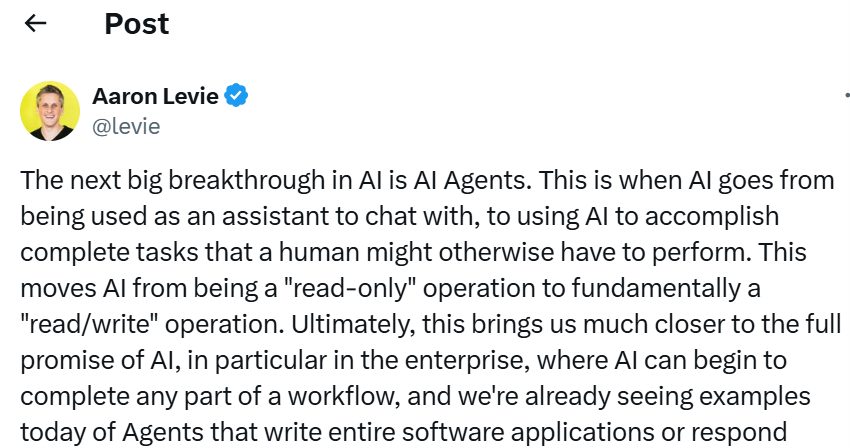
[click here for the full post]](https://x.com/levie/status/1782164161553961069)
Aaron’s viral post functioned like a mini-Manifesto – like the Jerry Maguire Brief, but about AI Agents for businesses instead of sports Agents. The post declares that AI Agents will democratize access to specialized skills, allowing businesses of all sizes to tap into resources previously available only to large organizations. Companies will automate routine tasks with AI Agents, freeing human talent to focus on higher-impact/higher-value work.
Business AI Agents will become the workhorses of the AI economy. Similar to how robots transformed manufacturing, Business AI Agents are reshaping human-centric industries. They can handle customer service, manage supply chains, conduct market research, and even negotiate deals with consumers in a Customer Acquisition context, like Symphony42.
Consumer AI Agents
While Business AI Agents are the current buzz, what is still under-discussed in July 2024 is the emergence and evolution of Consumer AI Agents. If Business AI Agents are the beast-of-burden workhorses, Consumer AI Agents are the loyal steeds for individuals. Like how smartphones became extensions of ourselves, these AI Agents will become our digital alter egos. They’ll manage our schedules, make purchases on our behalf, invest our money, and even represent us in digital environments. Imagine a world where your AI Agent negotiates with a Business AI Agent (or COUNTLESS Business AI Agents) to get you the best deal on a car, without you lifting a finger – all done at the speed of light, without the tiresome burden of slowing down for human communication comprehension :-O.
The interplay between Business AI Agents and Consumer AI Agents will create a new digital economy. It’s as if the Internet itself has come alive, with intelligent entities buying, selling, negotiating, and creating value autonomously. As this ecosystem matures, we’re moving towards a world where AI Agents could become the PRIMARY drivers of economic activity. Just as e-commerce transformed retail and social media revolutionized marketing, AI Agents have the potential to fundamentally alter how business is conducted, decisions are made, and value is created.
The businesses and consumers who can effectively harness this AI Agent ecosystem will become the economic leaders of tomorrow. We’re currently witnessing the birth of an entirely new economic paradigm.
More on this Consumer AI Agents interaction with Business AI Agents later in this article.
III. REVENUE-GENERATING AI AGENTS: The New Frontier
Just as the California Gold Rush sparked a wave of wealth creation, Revenue-generating AI Agents are the new gold mines in the era of AI. While cost-saving AI systems might be the equivalent of more efficient picks and shovels, Revenue-generating AI Agents are the prospectors, miners, and gold traders all rolled into one, actively creating new streams of cash flows. Revenue-generating AI Agents will always be one of the keys to “How to Make Money with AI.”
AI Sales Agents
Perhaps the most effective type of Revenue-generating AI agents is AI Sales Agents that sell high-value and highly-considered products and services to consumers. Envision these entities as the pinnacle of B2C Customer Acquisition evolution, seamlessly blending the best aspects of digital advertising and personalized sales assistance. Imagine clicking on an intriguing ad that doesn’t just lead to a static webpage but invites you into a conversation with a personalized AI Sales Agent. These agents are like having a world-class expert concierge at every digital doorstep across the Internet, ready to engage the moment a consumer shows interest or raises their hand.
When you click that ad, you’re not met with a pushy sales pitch, but a helpful expert assistant eager to understand and fulfill your needs. These AI Sales Agents can handle millions of these consumer-initiated interactions simultaneously, 24/7, in any language or cultural context. They don’t just respond to queries, they also engage in meaningful dialogues, learning from each interaction to provide increasingly personalized and valuable experiences. It’s as if every ad click could instantly connect you with the most knowledgeable, patient, and insightful sales representative imaginable – one that’s always improving and never tires. By transforming ad engagements into tailored, pressure-free conversations, these AI Sales Agents turn curious clicks into satisfied customers, creating a new paradigm of digital commerce where every interaction is an opportunity for relationship-building and value creation at an unprecedented scale.
AI Agents represent a radical paradigm shift in how businesses can generate revenue. They’re not just tools that make existing processes more efficient – they’re autonomous entities that proactively create net new value. Just as the Internet created entirely new business models like e-commerce and social media marketing, these Revenue-generating AI Sales Agents are forging new pathways to profitability in the AI economy.
The businesses that can effectively deploy and manage these Revenue-generating AI Sales Agents will find themselves not just participating in legacy markets but creating and dominating entirely new economic landscapes. This phenomenon isn’t just about cutting costs or incremental improvements in efficiencies – it’s about explosive, exponential growth in revenue generation capabilities.
Welcome to the new gold rush of the AI age – Revenue-generating AI Sales Agents :-)
IV. THE B2B2C MODEL: Leveraging AI Agents for Indirect Monetization
Understanding the B2B2C business model in the context of AI Agents
In “How to Make Money with AI – Part 1,” we explored the concept of Return on AI Investment (ROAI) and highlighted Google’s phenomenal success with their B2B2C (Business-to-Business-to-Consumer) business model. Just as Google became one of the world’s most valuable companies by connecting businesses with consumers through search-query targeted ads, AI Agents are poised to revolutionize this model, creating new avenues for indirect monetization of consumers using the same B2B2C model.
Imagine Google’s search engine as a vast, intelligent matchmaking service. Now, picture AI Agents as supercharged cupids orchestrating entire relationships. In this AI-Agentic B2B2C model, companies can potentially monetize billions of consumer interactions on the Internet without needing a business relationship with billions of consumers. Rather, the business relationship is with thousands of other businesses (advertisers) who want the attention of, and ultimately a business relationship with, the consumers.
Key components of a B2B2C AI Platform:
Consumer Engagement Layer
Think of this as the AI equivalent of Google’s search bar – a ubiquitous, user-friendly interface that consumers interact with naturally. But instead of just returning search results, this layer uses LLMs to understand context, intent, and even emotion. It’s like having a psychic friend who always knows what you need before you do. Conversational AI is an intrinsic aspect of consumer media.
Business Interface
This is akin to Google AdWords but exponentially more sophisticated. Businesses don’t just bid on keywords, rather they create AI-powered campaigns that dynamically adapt to consumer behavior. It’s like having a sales and marketing team that can instantaneously tailor millions of personalized pitches.
Matching Algorithm
The heart of most B2B2C technologies is a matching algorithm. If Google’s PageRank linear algebra was revolutionary, an AI matching system’s calculus would be a quantum leap forward. It doesn’t just match based on relevance, but on complex factors like consumer demographics, psychographics, timing, context, expected value (EV) and potential lifetime value (LTV). Imagine a matchmaker with perfect memory, unparalleled insight, and the ability to predict relationship success with uncanny accuracy.
Data Analytics and Learning Module
This is the brain of a B2B2C system, constantly evolving and improving. Like how Google’s algorithms learn from every search and every click, this AI module learns from every interaction, making the entire system smarter over time. It’s as if the entire Internet is one giant A/B or multi-variate test, with AI analyzing and optimizing countless attributes in real time.
AI’s role in transforming B2B2C interactions:
Hyper-Personalization at Scale
AI Sales Agents can tailor each consumer interaction based on a vast array of data points. It’s like having a personal shopper for every person on the Internet, but one that also understands the goals and offerings of millions of businesses.
Predictive Engagement
AI doesn’t just react to consumer queries, it anticipates needs. Imagine if Google could tell you what you’ll want to search for next week and connect you with the perfect business to fulfill that future need.
Seamless Omnichannel Presence
AI Agents can maintain consistent interactions across all ad platforms, traffic channels, and devices. It’s like having a salesperson who can simultaneously be in every store, website, and app, always remembering every detail of your preferences and always reconciling your absolute identity via your email address and/or cell phone number.
Real-Time Optimization
Every interaction feeds back into the system, allowing for instant adjustments. This is like having a stock market for consumer attention, with AI Agents as high-frequency traders, making millions of micro-optimizations per second.
Recommended by LinkedIn
[
It Was Never About AI
                Edison Gbenga Ade

  6 months ago](https://www.linkedin.com/pulse/never-ai-edison-gbenga-ade-elgnf)
[
Gen AI for Business Edition # 66: New Beginnings
                Eugina Jordan

  1 year ago](https://www.linkedin.com/pulse/gen-ai-business-edition-66-new-beginnings-eugina-jordan-wi2ee)
[
Debunking the Anti-AI Cult
                Maxwell Jensen

  1 year ago](https://www.linkedin.com/pulse/debunking-anti-ai-cult-maxwell-jensen-px8if)
Value Creation Through Insight
Beyond just connecting businesses and consumers, AI can generate valuable insights for both parties. It’s as if every transaction also produced a detailed market research report, helping businesses refine their offerings and consumers make better decisions.
In this AI-driven B2B2C model, the platform itself becomes an intelligent, active participant in the economy. It’s not just a marketplace, but rather a market maker, value creator, and growth engine all in one. Companies that can harness this model, like Symphony42 with its AI Customer Acquisition Platform, are positioned to become the “Googles of the AI age,” potentially monetizing every digital interaction and reshaping the very nature of commerce.
By leveraging AI Agents in a B2B2C model, businesses can tap into revenue streams that were previously unimaginable, turning every consumer touchpoint into an opportunity for value creation and monetization. This isn’t just a new way to advertise, it’s also a fundamental reimagining of how businesses, consumers, and technology interact in the Internet economy.
V. How We’ll Pay for AI Agents
Just as the California Gold Rush spawned an ecosystem of miners, picks and shovels sellers, and service providers, the AI Agent revolution is creating a diverse landscape of monetization strategies. Each approach represents a unique way to strike gold in this new digital economy.
Usage-based models
Similar to how cloud computing transformed tech infrastructure costs, usage-based pricing allows businesses to pay only for the volume of “work” produced by the AI Agents. It’s like having a pay-as-you-go superhuman workforce. AI Usage-based models can be observed in “per-token” and “per-second/minute” based pricing models. We expect the most capable AI Agents utilizing Usage-based models and eschew the classic SaaS per-user/seat, per-month pricing models of yesteryear.
Performance-based pricing models
This strategy is the digital equivalent of “no win, no fee” legal services, but supercharged by AI’s capabilities. Performance-based pricing models customarily absorb some of the customer risk and get paid only on positive outcomes, including:
-
Revenue sharing: Imagine affiliate marketing on steroids. AI Agents don’t just refer consumers, they also actively participate in the sales process, earning a cut of each successful transaction they facilitate.
-
Cost-per-Action (CPA): Similar to how Google Ads revolutionized advertising with its pay-per-click (CPC) pricing model, AI Agents can be compensated based on specific actions they drive, from consumer connection/handoff to completed sales.
-
Return on AI Investment (ROAI): As introduced in “How to Make Money with AI – Part 1,” this model ties AI Agent compensation directly to the measurable value they create beyond just transaction revenue, much like how venture capitalists earn carried interest on the growth they help facilitate.
The key is to understand that AI Agents aren’t just products or services – they’re active participants in the value-creation process. By aligning how we’ll pay for AI Agents with this fundamental shift, businesses can tap into revenue streams that were previously unimaginable with the appropriate balance of risk between AI Agent providers and their business customers.
VI. BUILDING AND SCALING AI AGENT BUSINESSES
Just as the e-commerce revolution transformed retail, Revenue-generating AI Sales Agents are set to revolutionize the very nature of B2C sales and Customer Acquisition.
Developing a Revenue-generating AI Sales Agent strategy for your business Identify Your Digital Storefront
Think of your AI Sales Agent as a virtual store on the busiest street in the largest city in the world. Your first step is to determine where this storefront should be. Will it be through social media ads, search engine marketing, or perhaps within popular messaging apps? This is akin to choosing between opening a store on New York’s 5th Avenue or in a bustling shopping mall.
Design Your AI Sales Agent
Just as Steve Jobs obsessed over every detail of Apple products, businesses need to meticulously design their AI Sales Agents. This includes its personality, knowledge base, and conversation flow via System Prompts, RAG methods, transfer learning, and fine tuning. Think of it as creating the perfect salesperson who embodies your brand values and never has a bad day.
Set Clear Objectives
Like how Jeff Bezos initially focused Amazon solely on books before expanding, start with a clear, specific goal for your AI Sales Agent. Is it to generate leads, close sales, or perhaps upsell existing customers? Your AI Agent needs a clear mission design to excel.
Plan Your Integration
Imagine your AI Sales Agent as a new star employee. How will it fit into your existing sales process? Will it handle initial inquiries, qualify/screen consumers, and then hand consumers off to human sales representatives? Or will it manage the entire sales cycle? This is similar to how companies had to restructure their legacy brick-and-mortar sales processes around e-commerce capabilities.
Implementation challenges and solutions:
Training and Continuous Learning
Your AI Sales Agent is like a prodigy that needs the right education. Initially, it may make mistakes, like how IBM Watson had to be carefully trained for its appearance on the “Jeopardy” TV game show. Implement a rigorous training regime and continuous feedback loop learning protocols to ensure your AI Agent keeps improving. Training and continuous learning can be achieved through dynamic Agent System Prompts, Agent Orchestration, RAG solutions, and LLM fine-tuning.
Human-AI Collaboration
Remember how ATMs were feared to replace bank tellers, but instead allowed them to focus on more complex tasks? Similarly, plan for how your human sales team will collaborate with AI Agents. This could involve humans handling complex negotiations while AI handles initial inquiries and follow-ups, or vice-versa. Or perhaps the objective is to replace the live human sales reps and call center agents entirely, which is well within the capabilities of AI Agents in 2024.
Scaling strategies for Revenue-generating AI Sales Agents:
Modular Design
Think of your AI Sales Agent system like Lego blocks. Create a modular design that allows you to easily add and swap new products, services, capabilities or even entire business lines. This is similar to how Amazon expanded from books to… well… everything. A modular design also lends itself well to “Champion/Challenger” methodology for third party vendors to compete with each other, like we employ at Symphony42.
Multi-Channel Deployment
Just as Disney expanded from theme parks to cruise lines to streaming services, deploy your AI Sales Agents across multiple channels. This could include websites, mobile apps, voice assistants, and even augmented reality platforms.
Personalization at Scale
Leverage the power of AI to offer Netflix-like personalization to millions of consumers simultaneously. Your AI Sales Agents should learn from every interaction to provide increasingly tailored experiences.
Global Expansion
Unlike traditional sales teams that require extensive training for new markets, AI Sales Agents can be rapidly adapted for new languages and cultures. This allows for Twitter-like global scaling, limited only by your ability to comply with local regulations.
Data Flywheel
Like how Google’s search engine improves with more searches, create a virtuous cycle where more customer interactions lead to smarter AI Agents, which in turn lead to better consumer experiences and more interactions. Lather, rinse, repeat.
Building and scaling an AI Sales Agent-driven business is not just about adopting new technology, it’s also about reimagining the entire concept of sales and customer interaction. Those who successfully navigate this new landscape will find themselves at the forefront of a revolution as significant as the shift from brick-and-mortar to e-commerce.
Remember, in this gold rush, the real winners won’t just be using AI picks and shovels. They’ll also be creating entire AI-powered mining operations that continuously discover new veins of gold. Your Revenue-generating AI Sales Agents are not just tools – they can be the harbingers of a new era in business, limited only by your imagination and ability to scale all the other aspects of your business.
VII. THE FUTURE: Personalized Consumer AI agents vs. Business AI Agents
Imagine a world where every individual has their own AI agent, as personal and indispensable as a smartphone is today. Now, envision these personalized Consumer AI Agents engaging with Business AI Agents in a complex dance of commerce, negotiation, and value creation. This isn’t science fiction – it’s the next frontier of AI Agent-driven business, and it’s closer than you might think…
The concept of Personal AI Agents
Consumer AI Agents will be the ultimate evolution of personal computing. If smartphones were an extension of our physical selves, Consumer AI Agents will become an extension of our digital selves – our interests, preferences, decision-making processes, and even our values.
Think of a Consumer AI Agents as a blend of JARVIS from Iron Man, Apple’s Siri, and a team of personal assistants, financial advisors, and life coaches, all rolled into one. These agents will eventually:
-
Manage our digital lives, handling everything from scheduling to content curation.
-
Make purchasing decisions based on our preferences and best interests.
-
Invest our money according to our risk tolerance and financial goals.
-
Negotiate on our behalf with businesses and their AI agents.
-
Continuously learn and adapt to our changing needs and preferences.
Just as social media platforms became the gatekeepers of our online social interactions, Consumer AI Agents will become the gatekeepers of our commercial interactions. They will filter out noise, identify opportunities, and ensure that every engagement with a business adds value to our lives.
How Business AI Agents will adapt
In this new landscape, Business AI Agents will need to evolve from simple sales tools to sophisticated relationship managers. They’ll be more akin to expert business development executives than traditional salespeople.
Business AI Agents will need to:
-
Develop emotional intelligence to understand and respond to the super-nuanced preferences of Consumer AI Agents.
-
Create hyper-personalized value propositions for each potential customer, mediated through their Consumer AI Agents.
-
Manage long-term relationships rather than focusing on one-time transactions.
-
Collaborate with other Business AI Agents to create bundled offerings that provide maximum value to consumers.
Imagine if Amazon’s recommendation engine could proactively negotiate with your personal Consumer AI Agent to create a custom bundle of products and services tailored exactly to your current needs and future plans. That’s the level of sophistication we’re heading towards.
AI-to-AI negotiations: A new paradigm in commerce
The interaction between Consumer AI Agents and Business AI Agents will usher in a new era of commerce, one that operates at the speed of light and with super-human-level complexity. This AI-to-AI negotiation will be like a futuristic stock market, where millions of transactions occur every second, each optimized for maximum value creation.
1. Speed and Efficiency: Negotiations that once took days or weeks will be completed in microseconds, with Consumer AI Agents and Business AI Agents rapidly iterating through offers and counteroffers.
2. Perfect Information: Unlike human negotiations, AI-to-AI dealings will operate with near-perfect information, leading to more efficient markets and optimal outcomes for both parties.
3. Complex Deal Structures: AIs will be able to consider vast numbers of variables simultaneously, creating intricate deal structures that maximize value in ways humans could never conceive.
4. Predictive Bargaining: Both Consumer AI Agents and Business AI Agents will use predictive models to anticipate future needs and preferences, negotiating deals that account for long-term value.
5. Collective Bargaining: Groups of Consumer AI Agents might band together for increased negotiating power, similar to labor unions or buying groups/clubs, but operating at AI speed and scale.
Imagine a world where your Consumer AI Agent negotiates with a car manufacturer’s Business AI Agents not just for the purchase of a vehicle, but for a holistic transportation solution that includes insurance, maintenance, fuel (or charging) costs, and even factors in your future travel plans and preferences. All of this happening in the blink of an eye, resulting in a perfectly tailored solution that neither a human salesperson nor a human consumer could have devised.
To my fellow tech entrepreneurs, we now stand at the threshold of this unprecedented new era. The AI agents we create today are the precursors to this future of commerce. By understanding and embracing this vision, your startup businesses can position themselves at the forefront of the most profound economic transformation since the invention of currency itself.
Welcome to the dawn of the AI Agent Economy.
VIII. CONCLUSION: Seizing the AI Agent Opportunity in the New Economy
The AI Agent revolution is here, and it’s redefining the rules of commerce. This article builds on the foundation laid in “How to Make Money with AI – Part-1,” further cementing AI as the most potent economic force in human history. From hyper-personalized Consumer AI Agents to sophisticated Business AI Agents, we’re witnessing a seismic shift in how value is created, exchanged, and captured.
Symphony42 stands at the forefront of this revolution. Our AI Customer Acquisition Platform isn’t just theoretical – it’s the practical application of everything we’ve discussed and is live and in production today. By harnessing Persuasive Conversational AI, we’re turning Internet traffic into new customers for businesses at unprecedented rates. Our AI Agents are outperforming traditional methods by handling millions of interactions simultaneously, tailoring each engagement to individual consumer needs, learning and optimizing with every interaction, and all without the limitations of human resources.
The future we’ve outlined – AI-to-AI negotiations, autonomous decision-making, and hyper-efficient markets – is rapidly becoming reality. Symphony42 is your gateway to this future.
For businesses ready to lead in this new era, the path is clear:
-
Embrace AI Agents as core to your strategy, not just as tools
-
Focus on creating value through AI-driven personalization and efficiency
-
Prepare for a world where Consumer AI Agents interface with your Business AI Agents
-
Partner with pioneers like Symphony42 to stay ahead of the curve
The AI Agent economy will create the next generation of industry titans. Will you be among them? Don’t just witness this revolution – be part of it. Symphony42 offers you the chance to harness the most advanced AI Customer Acquisition technology available. Our platform embodies the principles laid out in “How to Make Money with AI,” Part 1 and Part 2, turning plans into profits.
The time to act is now. Partner with Symphony42, and position your business at the forefront of the AI Agent revolution. Together, we’ll not just adapt to the future of commerce – we’ll define it.
Happy Independence Day Everyone :-)
Sean P. Fenlon
Symphony42 Founder/CEO
Originally published on LinkedIn. Read and comment on the original article →